


About the School
Winter Innovation School — a new initiative of Policy Area Innovation
On the forum of the EU Strategy for the Baltic Sea Region (EUSBSR), there are increasing calls to meaningfully involve young people in the activities of all its areas and levels. First and foremost, it is young researchers who will co-create the Region’s innovations — innovations that will shape its future.
The pilot Winter Innovation School 2025 is a novel initiative implemented this year at the University of Warsaw in connection with the activities of the Innovation Thematic Area (Policy Area Innovation) of the EUSBSR strategy. The sustainable development of innovation in the Region depends on the strategic skills of younger generations — skills we must nurture today.
The concept of the Innovation School emerged from consultations between the Ministry of Science and Higher Education and the Ministry of Economics Development and and Technology of Republic of Poland, within the Steering Group the Innovation Thematic Area of the EUSBSR strategy. The Innovation School is intended to address the unmet educational needs of young researchers in the fields of innovation and artificial intelligence.
Strategic coordination of innovation development in the Baltic Sea Region
Between 2022 and 2026, the Ministry of Science and Higher Education implements the EU-funded project: “Coordination and support for EUSBSR Policy Area Innovation (PACINNO-3)”. The project is carried out together with partners from Ministry of Economic Affairs and Communications (Estonia) and The Baltic Institute of Finland, under the Interreg Baltic Sea Region Programme 2021–2027. Its aim is to support the development of the Policy Area Innovation of the EUSBSR strategy.
The Ministry’s role is to coordinate the development of this area by stimulating and facilitating regional cooperation in innovation.
The project’s goal is to implement the three core pillars of Policy Area Innovation: challenge-driven innovation, digital innovation and transformation, co-creative innovation, in the Baltic Sea Region through:
- contributing to public policy debate on innovation and influencing its shape at EU, national, regional, and local levels,
- strengthening macroregional cooperation in innovation,
- supporting the creation of new projects and initiatives in innovation.


EU Strategy for the Baltic Sea Region
The European Union Strategy for the Baltic Sea Region (EUSBSR) was established in 2009 as the first macro-regional strategy of the European Union. It covers Denmark, Estonia, Finland, Lithuania, Latvia, Germany (northern federal states), Poland, and Sweden. Its three main objectives, pursued through strengthened cooperation among the region’s countries, are: improving the quality of the Baltic Sea ecosystem (Save the Sea), increasing regional cohesion (Connect the Region), and enhancing the region’s prosperity (Increase Prosperity).The Strategy consists of 14 Policy Areas, one of which is Policy Area Innovation.
Cooperation is carried out at multiple levels: governmental, regional, and local, with the participation of research and academic institutions, regional cooperation structures, NGOs, and the business sector. The implementation of the Strategy is based on the principles of multi-level governance, transparency, and openness to new stakeholders. The catalogue of cooperation formats is open and includes, among others, projects (individual or clustered), processes, networks, and cooperation platforms.
The National Coordinator of the Strategy is located within the Department of European Policy of the Ministry of Foreign Affairs.
Estonia currently holds the Presidency of the Strategy (until June 2026).
Poland’s participation in coordinating the Strategy
Poland currently co-coordinates 4 out of the 14 Policy Areas of the Strategy:
- Policy Area Nutri (Biogenic Substances) – coordinated byThe State Water Holding Polish Waters together with Finland,
- Policy Area Innovation (PA Inno) – coordinated by the Ministry of Science and Higher Education together with Estonia and Finland,
- Policy Area Culture (PA Culture) – coordinated by the Adam Mickiewicz Institute together with Germany (federal state of Schleswig-Holstein),
- Policy Area Tourism (PA Tourism) – coordinated by the Pomerania Regional Tourist Organization as the lead coordinator together with Finland.

Day I – Monday, 15 December
online live stream
| 10:30-10:40 | Opening of the Winter Innovation School by dr Karolina Zioło-Pużuk, the Secretary of State at the Ministry of Science and Higher Education |
|---|---|
| 10:40-11:00 | Welcome address by Prof. Alojzy Z. Nowak, the Rector of the University of Warsaw |
| 11:00-12:30 | Keynote: “Billion-Dollar Voices and Minority Languages: The Promise and Challenge of Speech Technology” by Prof. Matt Coler, University of Groningen |
| 12:30-12:45 | Coffee break |
| 12:45-13:00 | Presentation on the EU Strategy for the Baltic Sea Region — Baltic Sea Strategy Point |
| 13:00-13:15 | Presentation on the Interreg Baltic Sea Region Programme |
| 13:15-13:30 | Presentation on Interreg Volunteer Youth |
| 13:30-14:15 | Lunch |
| 14:15-15:45 | Lecture I — “Machine learning with examples” by Prof. Artur Kalinowski, Machine Learning Center UW, Faculty of Physics UW |
| 15:45-16:00 | Coffee break |
| 16:00-17:30 | Lecture II — “Psychological conditions of innovativeness and effective action” — Prof. Mirosława Huflejt-Łukasik, Faculty of Psychology UW |
| 17:30 | Closing of Day 1 of the School |
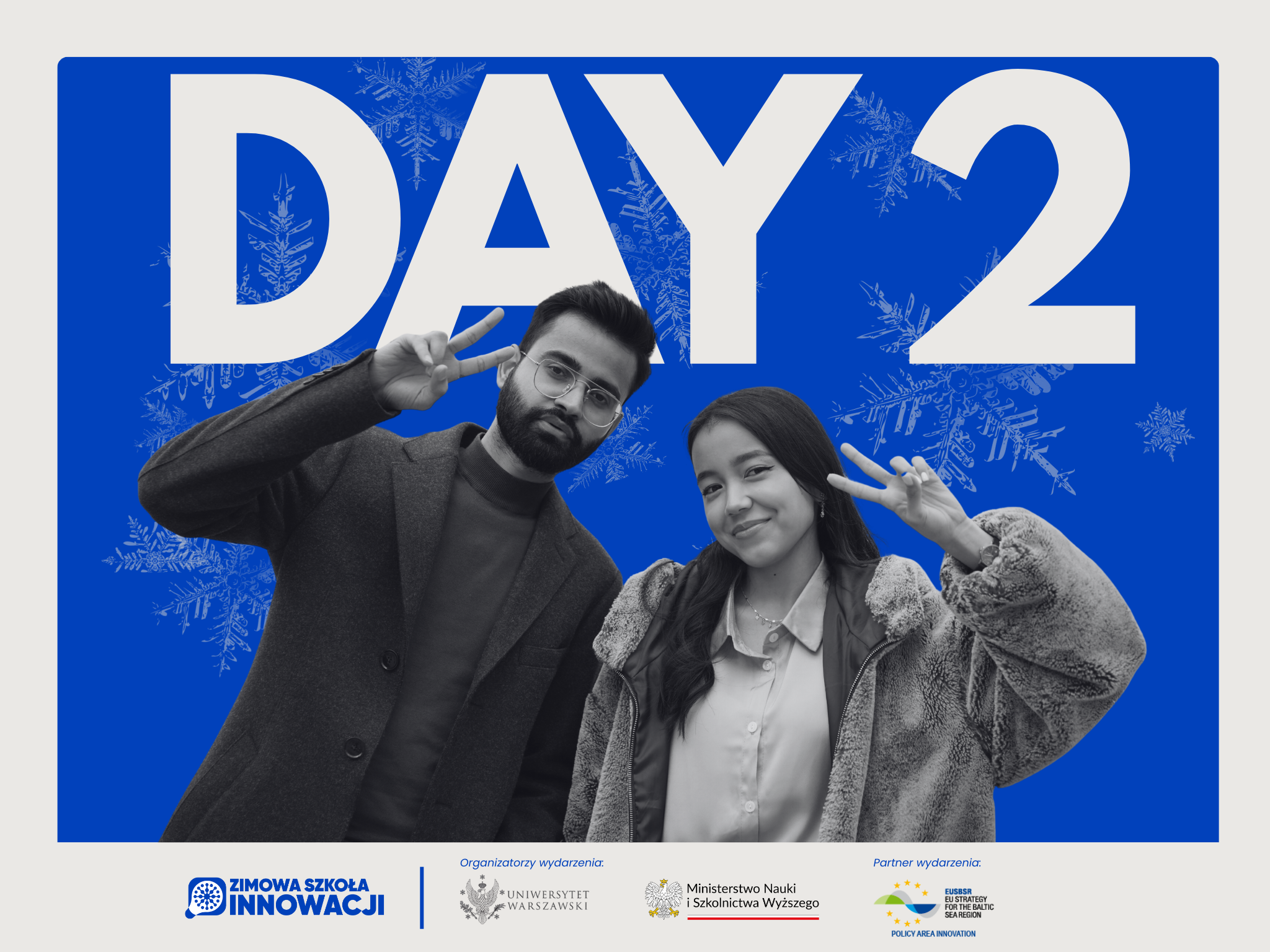
Day II – Tuesday, 16 December
in-person, closed workshops
| 09:00-10:30 | Group workshops |
|---|---|
| 10:30-10:45 | Coffee break |
| 10:45-12:15 | Group workshops |
| 12:15-13:00 | Lunch |
| 13:00-14:30 | Group workshops |
| 14:30-14:45 | Coffee break |
| 14:45-16:15 | Group workshops |
| 16:15 | Closing of Day 1 of the School |
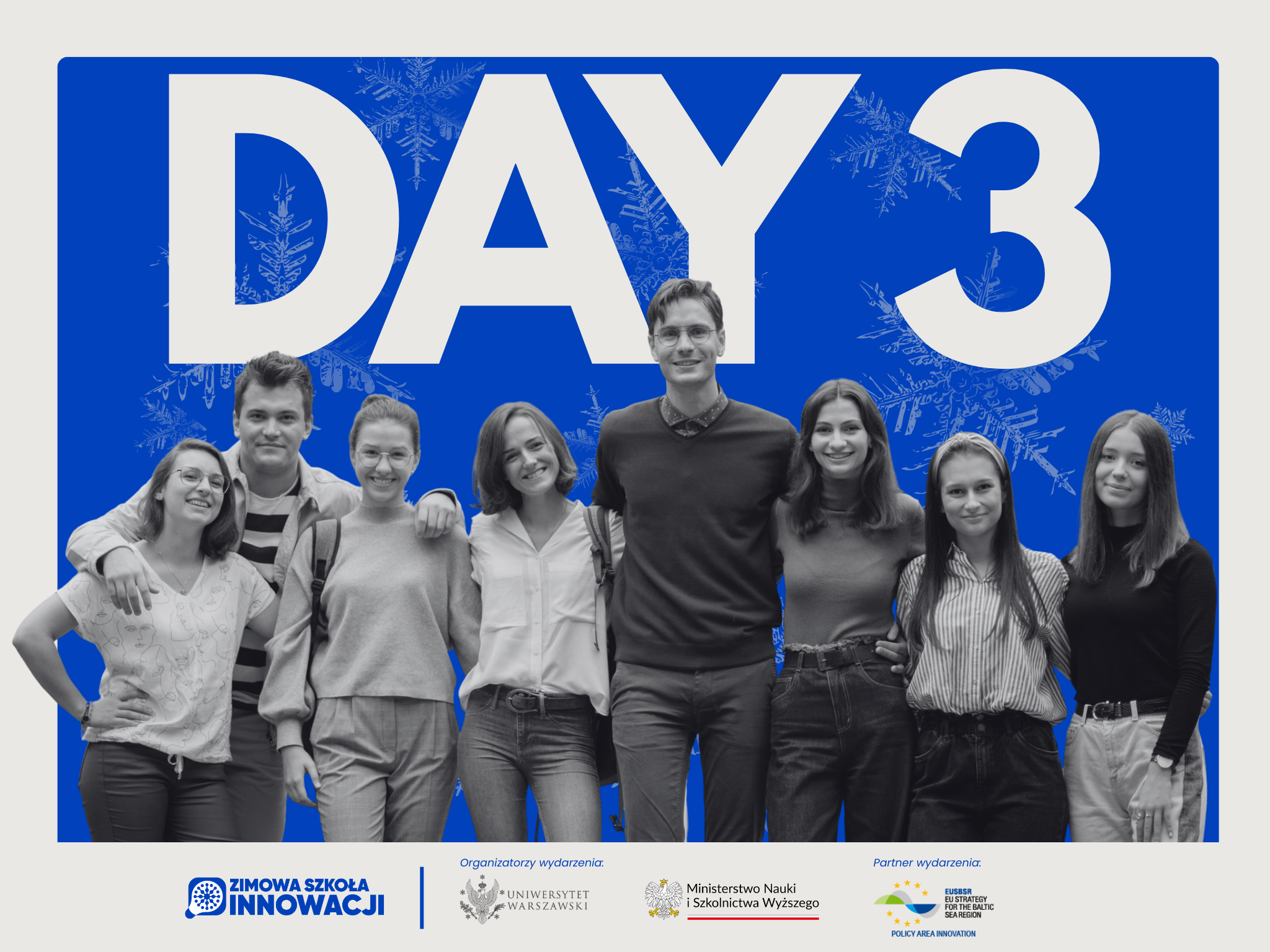
Day III – Wednesday, 17 December
in-person, closed workshops
| 09:00-10:30 | Group workshops |
|---|---|
| 10:30-10:45 | Coffee break |
| 10:45-12:15 | Group workshops |
| 12:15-12:30 | Family photo |
| 12:30-13:15 | Lunch |
| 13:15-14:00 | Winter School summary — plenary session |
| 14:00 | End of School |
Practical information
Location
Faculty of Psychology
University of Warsaw
2D Banacha S treet
02-097 Warsaw
Contact
If you have any additional questions regarding the “Winter School of Innovation,”
please feel free to contact us:
Winter School of Innovation Organizing Team
szkola.dr@uw.edu.pl
Event Organizers

Event Partner
Speakers

Billion-Dollar Voices and Minority Languages: The Promise and Challenge of Speech Technology, prof. Matt Coler (lecture)
About the lecture
Polish startup ElevenLabs has grown to a $3+ billion company creating AI voices that fool human listeners. OpenAI's ChatGPT, now the world's most valuable private company, converses in dozens of languages. These breakthroughs represent a revolution in speech synthesis—but they primarily serve languages with massive digital footprints. What about the other 7,000 languages? This keynote traces the innovation pathway enabling high-quality speech synthesis for minority languages using minimal data, just a few minutes of recordings. Through concrete examples the presentation demonstrates how combining machine learning with linguistic insight and sociolinguistic commitment transforms technical capability into real-world impact for underserved communities. For doctoral researchers thinking about innovation and commercialization, this talk reveals how breakthrough solutions emerge from interdisciplinary collaboration, how to identify opportunities where others see insurmountable barriers, and why measuring the right outcomes determines whether innovations truly serve their intended communities. The technology can now reach every language. The challenge for the next generation of researchers is ensuring it serves every community.
About the lecturer
Matt Coler is Associate Professor of Speech Technology at the University of Groningen, where he directs the MSc Speech Technology program and is head of the Governance and Technology department. He serves as Ethics Chair for Interspeech 2025, and recently served as Vice Chair of the LITHME COST Action, an EU-funded research network examining language technology in society. The research of his Speech Tech Lab brings together linguistic theory, AI ethics, and speech technology to expand access to language technologies for underrepresented communities.

“Machine Learning with Examples” – Prof. Artur Kalinowski, University of Warsaw Machine Learning Center (lecture)
About the lecture
Machine learning – and even more so AI – has become ubiquitous, showing up in places we’d never have expected for instance, in a fridge. During the lecture I will try to show what machine learning really is: a development of methods and tools that have been used since the dawn of computing. I also hope to show what it is not – a magical device that can produce something (i.e. answer a question) out of nothing (i.e. without any information). I will present the lecture in the form of a computational notebook, so participants will be able to take it home and continue experimenting with simple models on their own.
About the lecturer
Prof. Artur Kalinowski is a physicist specialising in experimental particle physics. For more than a quarter of a century, he has been analysing large datasets produced by experiments at the Large Hadron Collider (LHC) at CERN. For many years he worked on data analysis in the search for the Higgs boson in one of the many so-called decay channels – the systems of particles into which the Higgs boson decays. Dr Kalinowski’s specialisation has been, and still is, decays into two tau leptons: H→ττ. Advanced methods for analysing multidimensional data have been used at the LHC since the 2000s, once known as multiparameter methods (MultiVariate Methods, MVA), and today as machine learning. What truly fascinates Prof.Kalinowski is extracting information from any data, not only from the huge detectors for elementary particles. Since 2020 he has coordinated the work of the University of Warsaw Machine Learning Center, established under the IDUB programme. The Center helps researchers at the University of Warsaw build machine learning models to analyse data as diverse as scans of medieval Spanish manuscripts and microscopic images of synapses.

“Psychological Conditions of Innovativeness and Effective Action” – Prof. Mirosława Huflejt-Łukasik (lecture)
About the lecture
The lecture will focus on the psychological determinants of functioning that foster innovativeness and effective action. It will discuss the importance of goals and both conscious and automatic self-regulation around these goals, as well as the links between goal characteristics and achievement. The lecture will also touch on motivation – especially intrinsic motivation – and the conditions for effective action. Participants will learn what scientific research tells us about how to act when barriers and obstacles appear in the implementation of our plans, and what the sources of creativity are – that is, how to plan creatively while fully using one’s cognitive potential.
About the lecturer
Prof. Mirosława Huflejt-Łukasik works at the Faculty of Psychology, University of Warsaw, in the Department of Business Psychology and Social Innovation. She is head of the University of Warsaw Center for Applications of Psychology, an expert on the quality of practical education, and substantive coordinator of the competence module in ZIP – the “Integrated Development Programme of the University of Warsaw”, including entrepreneurship education programmes and the UW Leaders’ Academy.
She also heads postgraduate studies “Psychology in Practice – Personal Effectiveness in Professional and Private Life” and the “Leaders’ Academy”. Her research focuses, among other things, on effective functioning and ways of formulating goals, as well as on the effects and costs of change. She translates knowledge about psychological processes into advisory and coaching practice in organisations. She is the creator of the Multi-Level Concept service method for organisations and of the MLC School of Coaching and Group Work. For over 25 years she has supported organisations and their leaders in setting directions for company development, strategic goals and implementing change, managing human resources – including recruitment and employee effectiveness – and problem solving. She conducts individual and team coaching, as well as trainings on team building and leadership, communication skills, handling difficult and conflict situations, time management, and coping with stress.

“From Idea to Innovation: Commercialisation of Research Results for Doctoral Candidates” – Dr Michał Borowy (workshop)
About the workshop
This workshop is aimed at doctoral candidates interested in using the results of scientific research in practice and in developing their own innovation-oriented initiatives. The programme combines a solid introduction to innovation and innovative activities in enterprises with practical elements concerning research commercialisation and academic entrepreneurship. Participants will gain knowledge on how to understand innovation in the context of today’s economy, what forms commercialisation can take, and what the process of creating a venture based on research results looks like.
The workshop will also discuss personality and non-personality factors that influence the decision to start a business, helping participants better understand their own predispositions and potential challenges. An important part of the training consists of exercises related to validating business ideas, preparing professional presentations for investors, and learning the rules for successfully applying for public funding. Classes begin with a short “breaking the ice” activity to create an atmosphere conducive to cooperation and experience sharing.
The workshop combines theoretical knowledge with practical tools, giving participants a comprehensive view of the innovation process – from idea, through analysis and development, to preparation for market entry. The programme supports doctoral candidates in consciously planning their scientific and entrepreneurial career paths.
About the lecturer
Dr Michał Borowy is an economist, lecturer and practitioner. He is an advisor to small, medium and large enterprises within the Ministry of Funds and Regional Policy’s “Innovation Coach” programme. He serves as coordinator and trainer in UW Incubator acceleration programmes such as Spin-off Academy, Move On, Starter and Digital Health. He is a mentor in the EIT Manufacturing / DEMO 4Green, PIAP innovation programme for enterprise development.
He is project leader on behalf of the Warsaw University of Life Sciences (SGGW) in international consortia EIT Digital / DIN-ECO and EIT Digital / PIONEER+ aimed at strengthening innovation ecosystems (2022–24, 2025–27). He has many years of professional experience in technology transfer in life sciences. He specialises in innovation and innovative activities of enterprises. He has designed and supervised projects supporting science-business cooperation, technology audits, market needs research, creation of implementation offers and pre-implementation work at SGGW.
He studies phenomena accompanying the commercialisation of research results in Poland and abroad, including during research stays at Lund University, Sweden (top-100 university in QS Rankings). He is the author or co-author of numerous scientific publications (in this field) in English, Russian and Polish, published as articles and book monographs. He has been a speaker at many national and international conferences on economic development, innovation, technology transfer and research commercialisation. In 2020–23 he served as Secretary of the Board of the Association of Organisers of Innovation and Entrepreneurship Centres in Poland (SOOIPP).

“Project Under Control: Management Methods and Techniques” – Małgorzata Jakubiak (workshop)
About the workshop
This intensive training aims to equip participants with structured and practical knowledge on how to run projects at every stage of their implementation. The classes include an accessible theoretical introduction, numerous workshop exercises and case study analyses, allowing participants to immediately apply the tools and methods they learn. During the workshop, participants will discuss basic concepts and types of projects, management structures, and key project approaches – from classical, through agile, to hybrid methods. They will learn to formulate goals according to the SMART principle, identify and assess risks, and plan mitigation strategies. Particular emphasis is placed on developing practical skills such as change management, personal work organisation, effective communication within the project team and running project meetings. The workshop uses diverse teaching methods (discussion, group work, individual work), encouraging active participation and deeper understanding. It concludes with a summary discussion that allows participants to reflect on the competences acquired and consolidate their knowledge. Thanks to its practical character, the workshop prepares participants to independently plan, implement and supervise projects in various environments.
About the lecturer
Małgorzata Jakubiak is a senior specialist at the Project Section of the University of Warsaw Centre for Knowledge and Technology Transfer (CTTiW). Since 2014 she has been involved in the administration of research and development projects, including those funded by the European Union. Since 2018 she has managed projects implemented under programmes of the Ministry of Science and Higher Education that support commercialisation processes at universities.
She delivers trainings in project management and consults R&D project proposals, supporting teams in preparing substantive assumptions, budgets and risk analyses. She lectures at the UW Faculty of Biology and also teaches within the Open University of the University of Warsaw and the Children’s University Foundation. She combines practical and teaching experience, which allows her to communicate knowledge in an accessible and engaging way.

“Intellectual Property. Protect Wisely, Communicate Creatively” – Paweł Płatek (workshop)
About the workshop
This practical workshop shows how to move from an idea to effectively protecting and communicating the value of research results. Participants will learn how to identify elements of their projects that have innovation potential and how to secure them before publishing, presenting or talking to business partners. The workshop covers intellectual property rights, in particular industrial property rights and copyright. We will focus on how to protect intellectual property, what is worth securing, the most common risks and mistakes leading to loss of rights, and when disclosure of results is safe and when it blocks protection. Participants will learn to look at their research the way implementation-oriented teams do: what has value, what should be kept confidential and what can be shared.
Another important component of the workshop is the role of artificial intelligence in research processes – both its opportunities and its threats to IP protection. We will discuss how to use AI tools safely, what kind of data can and cannot be fed into them, and how AI-based technologies can support innovation analysis. We will also address cyber security issues, including data protection, secure sharing of project information, and minimising the risk of unauthorised disclosure of research results.
Participants will also learn how to communicate their research results effectively. We will show how to talk about one’s findings clearly and persuasively so that the audience, regardless of their level of expertise, understands what problem you are solving and why it matters. You will practise how to talk about a project without revealing details that could undermine IP protection, and how to prepare short, safe and accurate descriptions of your research. This is a hands-on workshop that will help you consciously protect your ideas, use modern technologies (including AI) safely, and communicate your achievements effectively so that your work can have a real impact both in academia and beyond. Promote and protect innovations from science effectively on the market and in the academic environment.
About the lecturer
Paweł Płatek holds a degree from the Faculty of Geology, University of Warsaw, and postgraduate qualifications from the “Managerial Studies – Higher Education Institution Management” programme. He is about to complete postgraduate studies in Corporate Communication at the UW Faculty of Journalism, Information and Book Studies.
He works in the Promotion and Marketing Section of the University of Warsaw Center for Technology and Knowledge Transfer. He collaborates with universities across Poland that are members of the Agreement of Academic Technology Transfer Centres. He provides consultations and support to the academic community in establishing spin-off companies, preparing implementation-oriented project proposals, and promoting good R&D practices.
He co-develops and delivers trainings and workshops for UW staff on research commercialisation and intellectual property protection. In his professional activities he also works with businesses in the area of university cooperation and initiates actions aimed at disseminating research results with commercialisation potential. He is coordinator of the UW Innovation Club and contributes to the creation of the UW Knowledge Management Platform.
Important! The workshop will be led by Marek Massalski and Renata Olejnik (CTTiW).

“Intellectual Property. Protect Wisely, Communicate Creatively” – Marek Massalski (workshop)
About the workshop
This practical workshop shows how to move from an idea to effectively protecting and communicating the value of research results. Participants will learn how to identify elements of their projects that have innovation potential and how to secure them before publishing, presenting or talking to business partners. The workshop covers intellectual property rights, in particular industrial property rights and copyright. We will focus on how to protect intellectual property, what is worth securing, the most common risks and mistakes leading to loss of rights, and when disclosure of results is safe and when it blocks protection. Participants will learn to look at their research the way implementation-oriented teams do: what has value, what should be kept confidential and what can be shared.
Another important component of the workshop is the role of artificial intelligence in research processes – both its opportunities and its threats to IP protection. We will discuss how to use AI tools safely, what kind of data can and cannot be fed into them, and how AI-based technologies can support innovation analysis. We will also address cyber security issues, including data protection, secure sharing of project information, and minimising the risk of unauthorised disclosure of research results.
Participants will also learn how to communicate their research results effectively. We will show how to talk about one’s findings clearly and convincingly so that the audience, regardless of their level of expertise, understands what problem you are solving and why it matters. You will practise how to talk about a project without revealing details that could undermine IP protection, and how to prepare short, safe and accurate descriptions of your research.
This is a hands-on workshop that will help you consciously protect your ideas, use modern technologies (including AI) safely, and communicate your achievements effectively so that your work can have a real impact both in academia and beyond. Promote and protect innovations from science effectively on the market and in the academic environment.
About the lecturer
Marek Massalski holds a degree in Management and Marketing from Warsaw School of Economics and postgraduate qualifications in Public Relations (Institute of Applied Social Sciences, UW) and Civil and Commercial Mediation (Lazarski University). He has 27 years of professional experience in B2B marketing, marketing strategy, B2B solution selling and consulting in strategic and operational marketing.
For seven years he has been associated with the University of Warsaw Center for Technology and Knowledge Transfer, where he is responsible for marketing and promotion of science and for supporting the commercialisation of research. He has cooperated with the Warsaw University of Technology, Warsaw University of Life Sciences and Jagiellonian University. For 21 years he has run his own boutique B2B marketing and PR agency specialising in communication and marketing in the B2B segment.
Important! The workshop is also led by Paweł Płatek and Renata Olejnik (CTTiW).

“Intellectual Property. Protect Wisely, Communicate Creatively” – Renata Olejnik (workshop)
About the workshop
This practical workshop shows how to move from an idea to effectively protecting and communicating the value of research results. Participants will learn how to identify elements of their projects that have innovation potential and how to secure them before publishing, presenting or talking to business partners. The workshop covers intellectual property rights, in particular industrial property rights and copyright. We will focus on how to protect intellectual property, what is worth securing, the most common risks and mistakes leading to loss of rights, and when disclosure of results is safe and when it blocks protection. Participants will learn to look at their research the way implementation-oriented teams do: what has value, what should be kept confidential and what can be shared.
Another important component of the workshop is the role of artificial intelligence in research processes – both its opportunities and its threats to IP protection. We will discuss how to use AI tools safely, what kind of data can and cannot be fed into them, and how AI-based technologies can support innovation analysis. We will also address cyber security issues, including data protection, secure sharing of project information, and minimising the risk of unauthorised disclosure of research results.
Participants will also learn how to communicate their research results effectively. We will show how to talk about one’s findings clearly and convincingly so that the audience, regardless of their level of expertise, understands what problem you are solving and why it matters. You will practise how to talk about a project without revealing details that could undermine IP protection, and how to prepare short, safe and accurate descriptions of your research.
This is a hands-on workshop that will help you consciously protect your ideas, use modern technologies (including AI) safely, and communicate your achievements effectively so that your work can have a real impact both in academia and beyond. Promote and protect innovations from science effectively on the market and in the academic environment.
About the trainer
Renata Olejnik is an expert in intellectual property protection and Head of the Intellectual Property Section at the University of Warsaw Center for Technology and Knowledge Transfer. She supports the academic community in matters related to IP protection, actively participates in designing IP protection processes, reviews contracts and coordinates the management of intellectual property at the University. She is co-author of the UW Regulations on Intellectual Property Management.
She has gained experience, among others, at the University of Leeds in the UK and through numerous national and international trainings. In 2019 she participated in the “Leaders in University Management” training at the University of Helsinki and took part in Erasmus programmes at the universities of Nottingham, Sheffield, York, Leeds and Malta. She is a graduate of the prestigious “Top 500 Innovators: Science – Management – Commercialization” programme of the Ministry of Science and Higher Education at the University of California, Berkeley (2015).
She served as a member of the UW Commission for Intellectual Property Management (2016–2020). She completed postgraduate studies “Training academic staff to teach Intellectual Property Protection” at the University of Warsaw. She teaches courses at UW for students and doctoral candidates and conducts trainings and workshops for UW staff on intellectual property and research commercialisation.
Important! The workshop is also led by Paweł Płatek and Marek Massalski (CTTiW).

“How Much AI in Science? Ethical Challenges of Using Artificial Intelligence in Scientific Research” – Prof. Dr hab. Paweł Łuków (workshop)
About the workshop
The aim of this workshop is to familiarise participants with the most important ethical challenges related to the use of artificial intelligence in academic work. Among others, the following issues will be discussed: the ethical dimension of scientific research; the ethos of science and institutional conditions of conducting research; ethical aspects of basic versus applied research (freedom of research, authorship of scientific achievements, research data management, intellectual property); sources of research ethics norms; conflict of interest in science; the problem of AI non-explainability; algorithmic bias; machine learning and fair use of publications; authorship of works created with the use of AI; ethics of scientific publishing in the context of AI; typical abuses in science related to the use of AI. Participants will gain knowledge of research ethics in the context of AI and skills necessary to apply this knowledge in research practice. The workshop will use interactive methods (case analyses and questions in small groups, discussion).
About the lecturer
Prof. Paweł Łuków is a philosopher, ethicist and bioethicist, author of numerous publications on research ethics, philosophy of medicine and medical ethics in leading scientific journals. He has many years of experience in ethical review of research projects in Poland and abroad (including within the Horizon Programme). He chairs the Rector’s Committee on Research Ethics Involving Human Subjects at the University of Warsaw and the Committee on Ethics in Science of the Polish Academy of Sciences (PAN). He is also a member of the European Group on Ethics in Science and New Technologies (an independent advisory body to the President of the European Commission) and of the Committee on Ethics in Science of the Polish Academy of Sciences.
Important! The workshop is also led by Dr Emilia Kaczmarek.

“How Much AI in Science? Ethical Challenges of Using Artificial Intelligence in Scientific Research” – Dr Emilia Kaczmarek (workshop)
About the workshop
The aim of this workshop is to familiarise participants with the most important ethical challenges related to the use of artificial intelligence in academic work. Among others, the following issues will be discussed: the ethical dimension of scientific research; the ethos of science and institutional conditions of conducting research; ethical aspects of basic versus applied research (freedom of research, authorship of scientific achievements, research data management, intellectual property); sources of research ethics norms; conflict of interest in science; the problem of AI non-explainability; algorithmic bias; machine learning and fair use of publications; authorship of works created with the use of AI; ethics of scientific publishing in the context of AI; typical abuses in science related to the use of AI. Participants will gain knowledge of research ethics in the context of AI and skills necessary to apply this knowledge in research practice. The workshop will use interactive methods (case analyses and questions in small groups, discussion).
About the lecturer
Dr Emilia Kaczmarek is a philosopher and ethicist with a PhD in the humanities, specialising in AI ethics. At the University of Warsaw she teaches lectures, workshops and seminars on the ethics of new technologies, including AI, as well as research ethics. She is the author of numerous scientific publications in leading philosophy journals.
Important! The workshop is also led by Prof. Dr hab. Paweł Łuków.

„Prompting AI” – Dr Agnieszka Marzęda (workshop)
About the workshop
The workshop introduces participants to practical applications of generative artificial intelligence in different work environments – from academic projects to educational and business tasks. The session will cover basic concepts, differences between language models and principles for consciously selecting AI tools for specific tasks, such as text analysis, information organisation, preparation of materials or content creation.
In the practical part, we will focus on developing skills in writing precise prompts, iterating instructions and building your own AI-based workflows. Participants will become familiar with tools that support project work, analysis, communication and teaching, and will see how these tools can streamline everyday tasks. The outcome of the workshop will be a set of techniques and ready-to-use procedures that participants can directly apply in their further work – regardless of their discipline or specialisation.
About the lecturer
Dr Agnieszka Marzęda is a lecturer at the Faculty of Journalism, University of Warsaw (Department of Social Communication and Public Relations), holds an MA in Marketing (WSZiM) and is a PR specialist (ISNS UW and IFiS PAN). She teaches courses and trainings in communication, including marketing and PR, and is a laureate of the PR Lions competition in the Education category.
For over 20 years she has been associated with the publishing industry, having worked as publishing director and overseen all stages of the publishing process. She serves as secretary of the Car of the Year Polska competition and is a member of the Sector Council for Competences in the Marketing Communication Sector, the Polish Public Relations Association and the Polish Society for Social Communication.
She has experience in running communication and marketing campaigns, e-commerce and activities supporting e-business. She specialises in digital marketing and the use of new technologies in business. She combines academic and business experience, conducts audits and prepares communication strategies. She actively supports the development of young talent in the AI Explorers Student Research Group, inspiring students to use new technologies in the media and business.